
Article: Your First Foil Assist Setup: AL vs D/LAB, Wings, Stabilizers & Tips

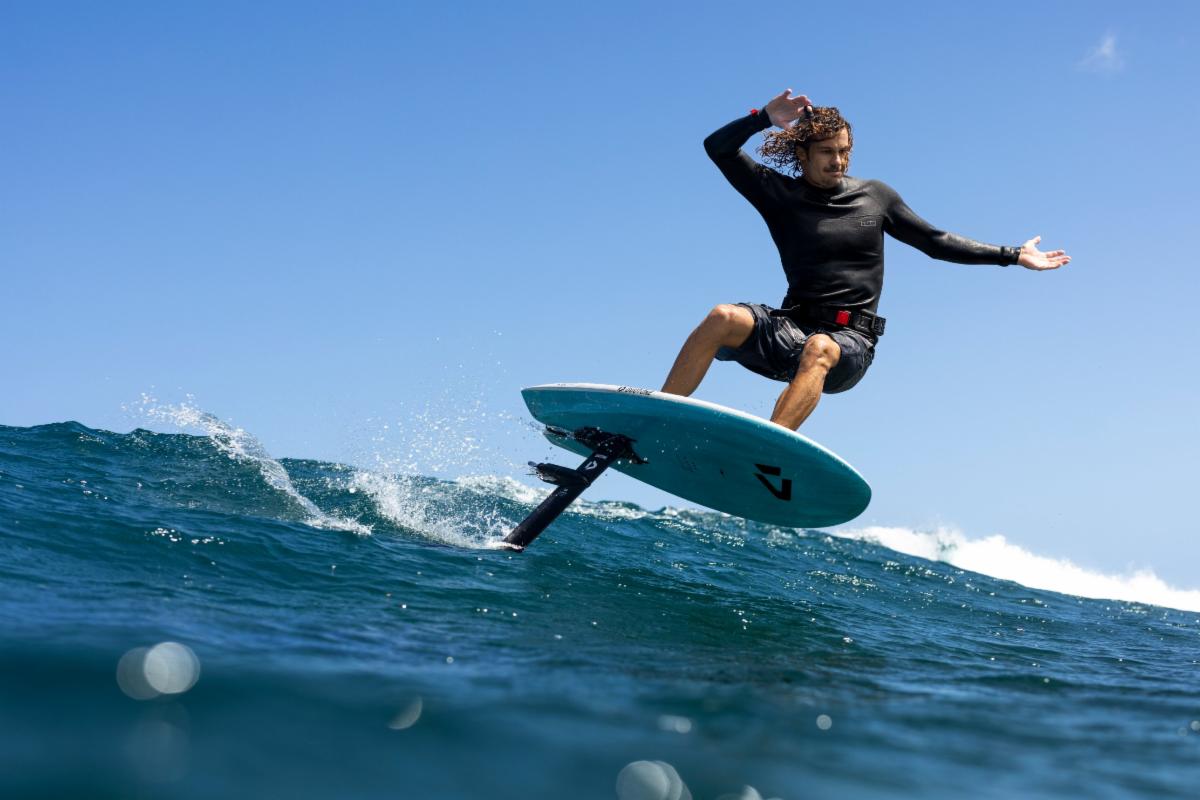
Your First Foil Assist Setup: AL vs D/LAB, Wings, Stabilizers & Tips
Thinking about a Duotone Foil Assist but not sure where to start? This guide walks through choosing a set, AL vs D/LAB compatibility, which front wing and stabilizer to pair with it, and what we tell every first-time rider before they paddle out.
Step 1: Assist, Cruise or Complete?
- Foil Assist Set AL ($5,699): the best place to start for most riders. The 84 cm aluminum mast works with Duotone foils and 10 other brands.
- Foil Assist Set D/LAB ($6,999): the lightest, slimmest, highest-performance mast. Built for experienced riders on Duotone foils.
- Foil Cruise Set AL ($5,699): a shorter 80 cm mast with the motor mounted low, plus an optional prop guard. Duotone calls it more suitable for novices. It's also the one for flat-water cruising.
- Complete sets (Assist or Cruise, from $7,514): the same systems with the board included. Pick these if you're starting from zero.
Step 2: D/LAB vs Aluminum, and why compatibility matters
This is the most important decision if you already own a foil.
| AL (Assist & Cruise) | D/LAB | |
|---|---|---|
| Material | Aluminum | Carbon |
| Length | 84 cm (Assist) / 80 cm (Cruise) | 84 cm |
| Duotone foils | Yes, with the $99 Duotone fuselage adapter | Yes, direct 3BS connection |
| Armstrong | Yes, with the Armstrong eFuselage + Duotone adapter | Yes, with the Armstrong eFuselage |
| Axis, F-One, Gong, Lift, North, Code, Sab, AFS, KT | Yes, with that brand's adapter ($149–$199) | No |
| Feel | Stiff, direct, more forgiving on the wallet | Lighter and slimmer, less drag, more playful turning |
Bottom line: if you ride anything other than Duotone or Armstrong, go AL. If you're all-in on Duotone and want the best performance, go D/LAB. Remember that no set includes a fuselage adapter, so add the right one to your order. The full breakdown by brand is on our compatibility chart.
Step 3: Choosing a front wing
Duotone's rule of thumb: use a front wing of at least 900 cm² with the Foil Assist. Bigger wings lift earlier at lower speeds, so the motor works less and your batteries last longer. Duotone recommends these:
- Free SLS (1500–2000): the most forgiving choice. Big, stable and early-lifting. Our pick for first sessions, especially on the Cruise.
- Glide 2.0 SLS (900–1350): long glide for prone and downwind. Great once you can ride a foil comfortably.
- Crest D/LAB (925 or 1050): Duotone lists Foil Assist as one of the Crest's disciplines. Smooth pumping and carving for prone and freefly.
- Glide 2.0 D/LAB (900): high-performance glide for experienced downwind riders, and a natural match for the D/LAB mast.
On the D/LAB mast, Duotone recommends the Crest D/LAB or Glide 2.0 D/LAB. With the AL masts, any of the four work.
Step 4: Choosing a stabilizer and fuselage
The stabilizer (back wing) and fuselage length control how stable or loose the foil feels:
- A bigger stabilizer and a longer fuselage give more pitch stability. That's what you want while you're learning to fly with the motor.
- A smaller stabilizer and a shorter fuselage feel looser and turn tighter. Move toward these as you progress.
Duotone's recommendations: with the AL masts, run the Aero AL 3BS fuselage or a Tail D/LAB fuselage with an S, H or C stabilizer. With the D/LAB mast, run the Monobloc Tail PX D/LAB, Monobloc Tail S D/LAB or Tail D/LAB. The Free and Glide wing sets come with a matched stabilizer, which is the simplest way to get a balanced setup.
Step 5: Pick a board
Any board with standard US foil tracks works. Duotone recommends at least 35 L for good battery performance, and more volume makes the first sessions much easier.
- Midfish: Duotone's purpose-built Foil Assist mid-length.
- Midfish Air: inflatable, 115 L, travel-friendly, with an extended fishtail that helps keep you away from the prop. Duotone pairs it with the Cruise mast for flat water.
- Paradox SLS: one board for wing, parawing, prone and Foil Assist.
- Crush SLS (4'5" / 35 L): compact prone board with integrated cable routing, for experienced riders.
Good first-time advice
- Practice with the remote on land first. Get comfortable turning the motor on, changing speed and turning it off before you're on the water.
- Start in flat water or small, clean waves, away from swimmers and other surfers.
- Use the motor to get up, then turn it off. That's what the Assist is for, and it stretches your 30–60 minutes of runtime.
- Go big on the first setup: more board volume, a bigger front wing and a bigger stabilizer. You can size down later.
- Start with the mast in the middle of the tracks and adjust in small steps.
- Wear a helmet and an impact vest. The propeller folds away when the motor is off, but treat it with respect. Never touch it while the system is powered on.
- Check the cable and leash before every session. The cable runs along a short board leash from your harness to the mast.
- Look after the batteries. Store them at two or three lights in a fire-resistant bag, and consider a second set for longer sessions.
- Rinse everything with fresh water after every session and keep the prop cover on when you're not riding.
Still not sure?
Email Yaz at yaz@calikites.com with your weight, where you ride and what gear you already have, and we'll put together the right setup. You can also browse the full E-Foil collection, read the Foil Assist guide or check the compatibility chart.